
For hospitals and clinics, running Google Ads is only one part of patient acquisition. The bigger challenge is making sure advertising spend generates qualified enquiries, appointments, and actual new patients.
A campaign can generate hundreds of clicks and still deliver poor business results if the budget is spent on low-intent searches, leads are poorly qualified, or enquiries are not converted into appointments.
That is why healthcare businesses should look beyond cost per click (CPC) and focus on Google Ads cost per patient acquisition.
Reducing patient acquisition cost does not simply mean getting cheaper clicks. It means improving the entire journey from advertising spend to patient conversion while maintaining the quality and volume of enquiries.
What Is Google Ads Cost per Patient Acquisition?
Google Ads cost per patient acquisition is the amount a hospital or clinic spends on advertising to acquire a new patient.
A simple calculation is: Patient Acquisition Cost = Google Ads Spend ÷ New Patients Acquired
For example, if a clinic spends ₹50,000 on Google Ads and acquires 25 new patients, its advertising cost per new patient is ₹2,000. However, healthcare businesses should distinguish between a lead, an appointment, and an actual patient.
A person submitting a form does not necessarily become an appointment. Similarly, an appointment does not always result in a completed consultation.Therefore, tracking the complete patient journey provides a more accurate understanding of Google Ads performance.
Ad Spend → Enquiry → Qualified Lead → Appointment → New Patient
Why Patient Acquisition Cost Matters More Than CPC
Cost per click is useful for understanding how expensive your advertising traffic is, but it doesn’t tell you whether those clicks generate business. Consider two campaigns:
Campaign A
- Lower CPC
- More clicks
- More enquiries
- Few appointments
Campaign B
- Higher CPC
- Fewer clicks
- Fewer enquiries
- More appointments
Campaign B may ultimately be more valuable to the hospital. This is why healthcare marketers should avoid optimizing campaigns solely around cheap clicks or low-cost leads.
Instead, evaluate:
- Cost per qualified enquiry
- Cost per appointment
- Cost per new patient
- Appointment conversion rate
- Revenue generated from acquired patients
The objective is not necessarily to obtain the cheapest traffic. It is to acquire the right patients at a sustainable cost.
Also Read: Google Ads for Healthcare
1. Identify Which Healthcare Services Generate Better Patients
Hospitals often promote multiple departments and treatments through Google Ads. However, not every service produces the same commercial results.For example, one campaign may generate a large number of enquiries but very few appointments, while another may produce fewer enquiries but significantly more consultations.
Analyze performance separately for each service or specialty. Consider:
- Advertising spend
- Qualified enquiries
- Appointments
- New patients
- Treatment value
- Patient acquisition cost
This can help identify which services deserve more budget and which campaigns require optimization. Budget decisions should be based on patient and business outcomes, not simply on traffic volume.
2. Find Where Patients Drop Out of the Conversion Journey
Patient acquisition is a funnel.A typical healthcare advertising journey looks like:
Google Search → Ad Click → Website Visit → Enquiry → Qualified Lead → Appointment → Patient
If performance drops at any stage, the overall acquisition cost can increase.
For example:
High impressions + low clicks
This may indicate a problem with search intent, ad relevance, or messaging.
High clicks + low enquiries
The problem may be related to the landing-page experience, offer, trust signals, or call to action.
High enquiries + low appointments
The issue may be lead quality, response time, or the appointment process.
High appointments + low patient attendance
The hospital may need to examine confirmation and reminder processes.
Rather than immediately increasing the advertising budget, identify the stage where the biggest loss is occurring.
3. Prioritize Search Traffic With Strong Patient Intent
Not every healthcare search represents the same level of intent. Someone searching for general information about a medical condition may not be ready to contact a healthcare provider. Another person searching for a specialist or treatment in a specific location may be much closer to making an appointment. This means healthcare advertisers should analyze the quality of traffic generated by their campaigns.
Look for search terms that consistently contribute to qualified enquiries and appointments. At the same time, identify searches that generate traffic but little business value. This helps shift the campaign from traffic acquisition toward patient acquisition.
4. Use Search Term Data to Control Wasted Spend
Even well-structured campaigns can receive searches that are not relevant to the services being promoted. Regularly reviewing actual search queries can reveal where advertising spend is being wasted. For example, a healthcare campaign may receive searches related to:
- Jobs
- Courses
- Training
- Salaries
- Free resources
- Academic information
- Unrelated services
Where appropriate, irrelevant queries can be added to the negative keyword strategy. This helps concentrate the advertising budget on searches that have a stronger connection to the hospital’s services and patient demand.
5. Improve the Lead-to-Appointment Conversion Rate
Reducing patient acquisition cost isn’t only about optimizing Google Ads. The process after a person submits an enquiry can have a major impact on the final acquisition cost. Imagine a campaign generates 100 qualified enquiries. If only 10 become appointments, the hospital has a 10% enquiry-to-appointment conversion rate.
If the hospital improves that process and 20 become appointments, the same advertising investment can produce twice as many appointments. Hospitals and clinics can improve this stage through:
- Faster response to enquiries
- Clear appointment procedures
- Prompt phone follow-up
- Appropriate WhatsApp communication
- Appointment confirmation
- Reminder systems
- Lead qualification
Marketing teams and front-office teams should therefore evaluate patient acquisition together.
6. Allocate Budget Based on Patient Acquisition Results
A common approach is to distribute the same budget across every campaign. However, healthcare businesses can often make better decisions by comparing campaign efficiency.
Analyze performance by:
- Specialty
- Treatment
- Location
- Campaign
- Device
- Search intent
- Time period
If one service consistently produces qualified patients while another generates mostly low-quality enquiries, the campaigns should be investigated before equal budgets are maintained. This does not mean immediately stopping an underperforming campaign. Instead, determine whether the problem comes from targeting, search demand, conversion experience, lead handling, or campaign structure.
7. Analyze Patient Acquisition by Location
Location can significantly influence healthcare advertising performance. A hospital may serve patients from several cities or neighbourhoods, but some locations may produce stronger patient demand than others.
Compare locations based on:
- Advertising spend
- Qualified enquiries
- Appointment bookings
- New patients
- Acquisition cost
For example, a location generating many clicks but very few appointments may require further investigation. Meanwhile, another area with lower traffic but stronger appointment conversion could represent a better opportunity. This approach is particularly useful for hospitals with multiple branches or clinics targeting defined geographic service areas.
8. Separate New Patient Acquisition From Existing Demand
Not every person who clicks a healthcare advertisement is a new potential patient. Some people may already know the hospital and search for its name before contacting it. Understanding branded and non-branded demand can therefore help marketers interpret campaign performance more accurately.
Branded searches may help capture existing demand, while non-branded searches can help a hospital reach people who are discovering its services for the first time. The two types of traffic can have different roles in a patient acquisition strategy.
9. Connect Google Ads Data With Actual Patient Outcomes
Google Ads can provide information about clicks, conversions, and advertising costs, but those numbers may not tell the entire story. A campaign might report 50 conversions, but the hospital’s internal records may show that only 15 became genuine appointments.
Connecting advertising data with appropriate CRM, call, appointment, or lead-management data can provide a clearer picture of campaign effectiveness.
This allows healthcare businesses to identify:
Which campaigns generate enquiries?
Which campaigns generate qualified patients?
Which services generate appointments?
Which locations produce better patient acquisition costs?
The closer marketing data is connected to actual business outcomes, the more effectively budgets can be optimized.
10. Measure Cost per Qualified Patient Instead of Just Cost per Lead
Cost per lead is useful, but it should not be the final metric.
For example:
Campaign A: ₹500 per enquiry
Campaign B: ₹1,000 per enquiry
Campaign A may appear twice as efficient.
But if most Campaign A enquiries are irrelevant while Campaign B produces qualified patients, Campaign B could provide significantly better business value. Healthcare organizations should therefore progress through a more complete measurement framework:
Cost per Lead → Cost per Qualified Lead → Cost per Appointment → Cost per New Patient
This provides a clearer understanding of the real cost of patient acquisition.
11. Review Acquisition Cost Against Patient Value
A sustainable healthcare advertising strategy should consider not only how much a patient costs to acquire but also the value that patient can generate. Treatment value, repeat consultations, follow-up services, and other appropriate patient relationships can influence the economics of acquisition.
For example, spending ₹2,000 to acquire a patient may be reasonable for one service but difficult to justify for another.
Therefore, hospitals should establish acquisition targets based on their own:
- Treatment economics
- Patient value
- Appointment conversion rate
- Operating capacity
- Marketing objectives
There is no single patient acquisition cost that works for every healthcare organization.
Should Hospitals Reduce Their Google Ads Budget?
Not necessarily. Reducing advertising spend can lower total costs, but it can also reduce patient volume. The better objective is to improve efficiency. If a campaign consistently generates qualified patients at a sustainable acquisition cost, increasing its budget may make more sense than cutting it. On the other hand, campaigns producing poor-quality traffic should be reviewed before an additional budget is allocated.
The question should be:
“How much can we profitably invest to acquire a new patient?”
rather than:
“How can we spend the least?”
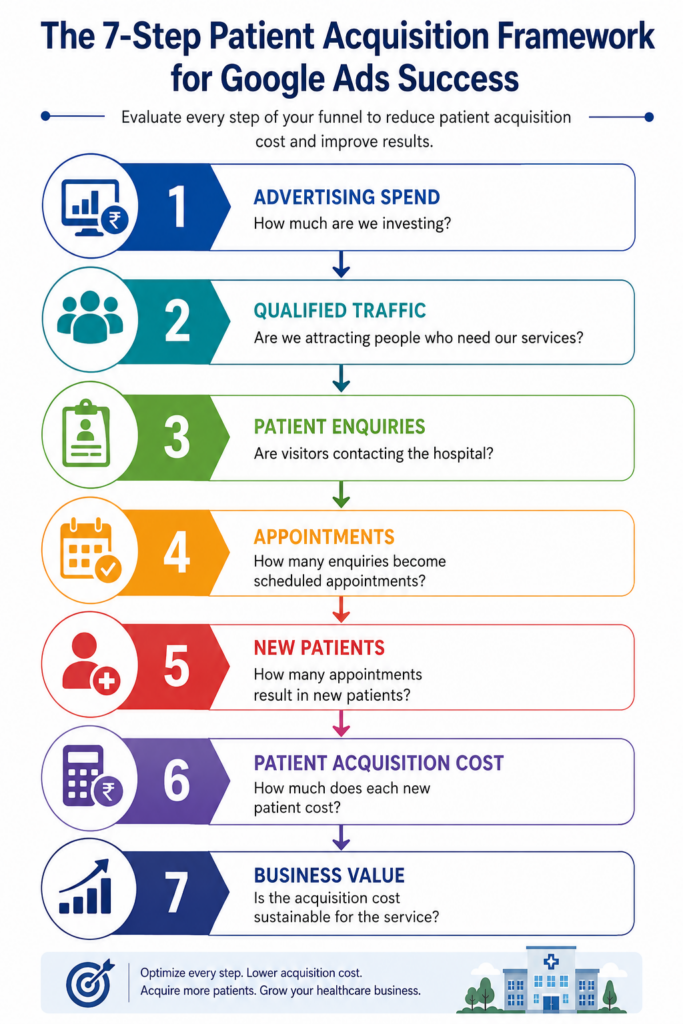
A Better Framework for Reducing Patient Acquisition Cost
Final Thoughts
Reducing Google Ads cost per patient acquisition is about optimizing the entire patient journey, not just lowering CPC. By improving targeting, budget allocation, lead follow-up, and conversion tracking, hospitals and clinics can achieve better results.
If your hospital or clinic is investing in Google Ads but struggling to convert advertising spend into qualified patient enquiries and appointments, Harvee Healthcare can help build a data-driven healthcare PPC strategy focused on measurable patient acquisition and sustainable growth.